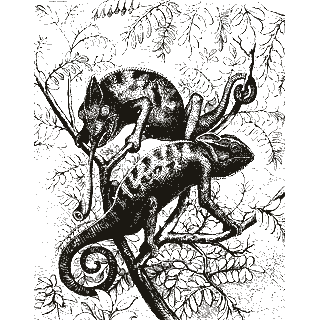
Reptiles & amphibians · plate 42 of 60
Chameleon
Chamaeleo chamaeleon
Changes color. Mostly to say leave me alone.
Only 1.3% of people are Chameleons. (estimated)
If you're a Chameleon
You are easy to miss and you prefer it that way. People say you blend in, but what you actually do is adjust: the room, the mood, the company, and you shift to match, which costs you more than anyone sees. You notice everything in two directions at once. You keep to your own branch. Company drains you faster than most people believe is possible.
A chameleon's color changes are mostly for signaling to other chameleons and managing body temperature; hiding is a side effect.
The Chameleon as a spirit animal
You adapt faster than anyone around you, and you do it quietly, without being asked, which means nobody ever thanks you for it. You have read a room before you have entered it. The cost is that constant adjusting is work, and the flaw is that you sometimes forget what color you were to begin with. A chameleon's brightest colors come out in anger or courtship; the rest of the time it is saving them.
Grounded in how the species actually lives; nothing borrowed from anyone's tradition. Why we put it that way.
How to get along with a Chameleon
Do
- Give them a quiet corner at the party and don't announce that they are in it.
- Ask one question and wait; the answer arrives slowly and in full.
- Let them set the pace; a chameleon crosses a room one deliberate foot at a time.
Don't
- Don't put them on the spot in a group; they go dark, and not metaphorically.
- Don't take the matching for agreement. It is camouflage, not a vote.
When it goes wrong: A cornered chameleon puffs up, gapes and hisses; back off, lower the volume and let it get to a branch.
The Chameleon in a relationship
You take a long time to show your colors, and when you do, it is unmistakable: brighter, bolder, the full display. You are not built for constant company, even with someone you like, and you need your own branch to return to. You love in intervals, intensely, then disappear to recover.


Field notes
Every animal is placed on six personality traits derived from how the species lives. Your answers are placed on the same six, and the closest animal wins. How the scoring works
- Sociability
- 0
- Boldness
- 2
- Energy
- 2
- Curiosity
- 6
- Devotion
- 0
- Roaming
- 1
- Its eyes move independently and together give it a nearly complete view of its surroundings.
- The tongue shoots out faster than the eye can follow and can be longer than the body.
- Chamaeleo chamaeleon is the only chameleon that lives wild in Europe, with footholds in southern Iberia, Greece and Cyprus.
Chameleons in literature
- The Chameleon — The Chameleon, James Merrick (1744)
- Unwaba the Chameleon — Nursery Tales, Traditions, and Histories of the Zulus, traditional (Zulu), collected by Henry Callaway (1868)
- The Chameleon — Metamorphoses, Book XV, Ovid (8)
Characters from public-domain works. Company, not a verdict.
Closest personalities
The animals whose profiles sit nearest to the Chameleon's. If you got Chameleon, one of these was probably your runner-up.


Other reptiles & amphibians
Among the 60
Animal Coloration, Frank Evers Beddard (1892). Public domain, viacommons.wikimedia.org.All credits
