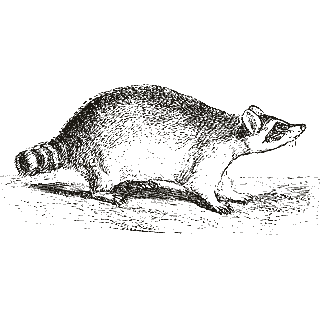
Mammals · plate 21 of 60
Raccoon
Procyon lotor
Has already worked out how your bin opens.
Only 2.0% of people are Raccoons. (estimated)
If you're a Raccoon
You find out how things work by taking them apart, usually at night, usually without asking. In a 1908 study raccoons opened eleven of thirteen complex locks and kept opening them when the locks were turned upside down; you have the same relationship with other people's cupboards. You are brave about problems, shy about feelings, and your hands are never still.
The Latin name lotor means washer, but raccoons are not cleaning their food; wetting the forepaws makes the skin more sensitive, so they dunk things to feel them better.
The Raccoon as a spirit animal
Matching a Raccoon means you are the person who solves the problem nobody asked you to solve, with whatever was within reach. Curiosity is your engine; it also means you have opened things that should have stayed shut. You adapt to any city, keep your own hours and prefer small company to a crowd. Nobody has ever successfully raccoon-proofed anything, and nobody will successfully you-proof anything either.
Grounded in how the species actually lives; nothing borrowed from anyone's tradition. Why we put it that way.
How to get along with a Raccoon
Do
- Give them a puzzle, not a lecture; they learn with their hands.
- Expect them at odd hours and don't take the schedule personally.
- Secure anything you don't want investigated. They will respect it exactly as long as it holds.
Don't
- Don't corner them; a raccoon with no exit stops being cute very quickly.
- Don't assume the mess means they weren't paying attention. They were.
When it goes wrong: Under pressure a Raccoon goes quiet, climbs out of reach and waits for dark; leave the route open and something edible nearby, then let them come back on their own.
The Raccoon in a relationship
You are slow to let anyone close and quick to lose interest in anyone boring. Raccoons meet to mate and then go their separate ways, so you may need reminding that staying is allowed. When you do stay, you are inventive, nocturnal and extremely good at finding the snacks.


Field notes
Every animal is placed on six personality traits derived from how the species lives. Your answers are placed on the same six, and the closest animal wins. How the scoring works
- Sociability
- 4
- Boldness
- 7
- Energy
- 7
- Curiosity
- 10
- Devotion
- 5
- Roaming
- 4
- Raccoons can remember the solution to a puzzle for up to three years.
- Two pairs released in Germany in 1934 are the ancestors of a population now found across much of central Europe.
- Raccoons do not hibernate, but in cold winters they sleep in a den for weeks at a time, living off fat put on in the fall.
Raccoons in literature
- Brer Coon — Uncle Remus: His Songs and His Sayings, Joel Chandler Harris (1880)
- Bobby Coon — The Adventures of Bobby Coon, Thornton Burgess (1918)
- Mr. 'Coon — The Hollow Tree, Albert Bigelow Paine (1898)
Characters from public-domain works. Company, not a verdict.
Closest personalities
The animals whose profiles sit nearest to the Raccoon's. If you got Raccoon, one of these was probably your runner-up.


Other mammals
WolfRed FoxBrown BearPolar BearLionTigerLeopardCheetahElephantGiraffeHippopotamusGorillaOrangutanSlothKoalaKangarooPlatypusOtterBeaverBadgerHedgehogBatCamelDolphinSperm Whale
Among the 60
Mammalia: Their Various Orders and Habits, Louis Figuier (1870). Public domain, viacommons.wikimedia.org.All credits
