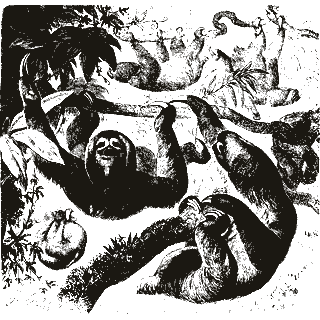
Mammals · plate 14 of 60
Sloth
Bradypus tridactylus
Does one thing a week. Chooses it carefully.
Only 1.3% of people are Sloths. (estimated)
If you're a Sloth
You are unhurried to a degree that other people find either restful or alarming. Sloths move slowly to save energy on a diet of leaves and come down to the ground about once a week; you also do the essential things on your own schedule and skip the rest. You are not lazy. You are running a very tight energy budget.
A three-toed sloth climbs down from its tree about once a week to defecate, and that trip is the most dangerous thing it does.
The Sloth as a spirit animal
You conserve. You don't waste movement, words or outrage, and you are remarkably hard to upset because upset takes energy. People underestimate you right up until they notice you got there anyway. The flaw is that your budget has no line for other people's urgency, and you will not be hurried, even when you should be. You will come down from the tree. On the day. Possibly.
Grounded in how the species actually lives; nothing borrowed from anyone's tradition. Why we put it that way.
How to get along with a Sloth
Do
- Let things take the time they take; a sloth's digestion runs on weeks.
- Meet them where they are, which is in the tree.
- Value what they do get done; the week's one task was chosen with care.
Don't
- Don't try to speed them up; the metabolism is the metabolism.
- Don't mistake stillness for absence; a sloth is watching, slowly, with its head turned right round.
When it goes wrong: A threatened sloth has few options and will use its claws if cornered; back off and let it return to being still.
The Sloth in a relationship
You love quietly and without hurry. Sloths are solitary and meet briefly to mate; the mother then carries her single young on her chest for months, close and unhurried. You are not demonstrative. You are, however, exactly where you were the last time your partner looked, which has its own value.


Field notes
Every animal is placed on six personality traits derived from how the species lives. Your answers are placed on the same six, and the closest animal wins. How the scoring works
- Sociability
- 1
- Boldness
- 2
- Energy
- 0
- Curiosity
- 3
- Devotion
- 4
- Roaming
- 0
- Sloths have one of the lowest metabolic rates of any mammal, and their body temperature drifts with the weather more than most mammals allow.
- Three-toed sloths have extra neck vertebrae, so they can turn their heads most of the way around without moving the body.
- Sloth fur hosts algae, moths and beetles, and the greenish tint helps the animal disappear into the canopy.
Sloths in literature
- The sloth — Histoire Naturelle, Comte de Buffon (1765)
- The sloth — Wanderings in South America, Charles Waterton (1825)
- The perico ligero — Historia general y natural de las Indias, Gonzalo Fernandez de Oviedo (1535)
Characters from public-domain works. Company, not a verdict.
Closest personalities
The animals whose profiles sit nearest to the Sloth's. If you got Sloth, one of these was probably your runner-up.


Other mammals
WolfRed FoxBrown BearPolar BearLionTigerLeopardCheetahElephantGiraffeHippopotamusGorillaOrangutanKoalaKangarooPlatypusOtterBeaverBadgerRaccoonHedgehogBatCamelDolphinSperm Whale
Among the 60
Gustav Mützel (1839–1893), Brehms Tierleben, Alfred Brehm (1890). Public domain, viacommons.wikimedia.org.All credits
